By: Christine Joyce Reyes
“You spend your whole life stuck in the labyrinth, thinking about how you’ll escape one day, and how awesome it will be, and imagining that future keeps you going, but you never do it. You just use the future to escape the present.”
John Green, Looking for Alaska

(photo not mine)
Looking for Alaska is basically a young adult book. When you read it, you’ll observe that the insight it shares is about friendship, loyalty, acceptance, life, loss, death, and suffering – mostly suffering.
Miles Halter, obsessed with last words, leaves Florida to attend boarding school, quoting François Rabelais’s last words: “I go to seek a Great Perhaps”. Miles’ new roommate, Chip Martin introduced Miles to his friends: Takumi and Alaska Young, a beautiful but emotionally unstable girl. Learning of Miles’ obsession with famous last words, Alaska informs him of Simón Bolívar’s: “Damn it. How will I ever get out of this labyrinth!” The two make a deal that if Miles will figure out what the labyrinth is, Alaska will find him a girlfriend.
“He—that’s Simon Bolivar—was shaken by the overwhelming revelation that the headlong race between his misfortunes and his dreams was at that moment reaching the finish line. The rest was darkness. Damn it,” he sighed. “How will I ever get out of this labyrinth!”
“So what’s the labyrinth?” I asked her.
“That’s the mystery, isn’t it? Is the labyrinth living or dying? Which is he trying to escape—the world or the end of it?”
Throughout the story, Alaska and Miles grew closer and he begins to fall in love with her, but she insists on keeping their relationship intimate but not sexual because she has a boyfriend that she loves.
“I wanted so badly to lie down next to her on the couch, to wrap my arms around her and sleep. Not fuck, like in those movies. Not even have sex. Just sleep together in the most innocent sense of the phrase. But I lacked the courage and she had a boyfriend and I was gawky and she was gorgeous and I was hopelessly boring and she was endlessly fascinating. So I walked back to my room and collapsed on the bottom bunk, thinking that if people were rain, I was drizzle and she was hurricane.”
The gang celebrates by drinking and partying, and a drunk Alaska revealed about her mother’s death from an aneurysm when she was eight years old. She said she felt guilty for not calling 911. Miles figured that her mother’s death made Alaska the girl he will never understand.
“Sometimes I don’t get you,’ I said.
She didn’t even glance at me. She just smiled toward the television and said,
“You never get me. That’s the whole point.”
“What you must understand about me is that I’m a deeply unhappy person.”
Alaska Young
A week later, after another episode of partying, drunk Alaska and Miles spent the night in each other’s presence, when suddenly Alaska received a phone call which caused her to go wildly emotional. Saying that she has to leave, Alaska drives away while drunk with Miles and Chip distracting the head of the boarding school, Mr. Starnes.
The next morning, Mr. Starnes asked the whole student body to gather up in the school’s gymnasium.

They later learn that Alaska has crashed her car and died.
Miles and Chip were both devastated.
Miles found Alaska’s copy of “The General in His Labyrinth” with the labyrinth quote underlined and notices the words “straight and fast” written on the side.
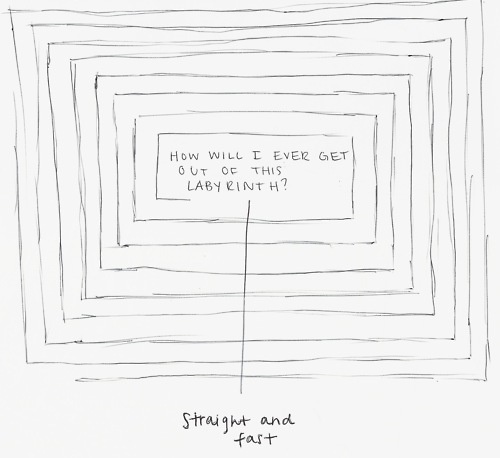
He remembers Alaska died on the morning after the anniversary of her mother’s death and concludes that Alaska felt guilty for not visiting her mother’s grave and, in her rush, might have been trying to reach the cemetery (or that she might have killed herself). On the last day of school, Takumi confesses in a note that he was the last person to see Alaska, and he let her go. Miles realizes that letting her go doesn’t matter as much anymore. He forgives Alaska for dying, as he knows Alaska would forgive him for letting her go.
Miles knew that the only way out of the labyrinth of suffering is to forgive.

 My Cup Of Tea